How to run the Graphical User Interface version of SPMF
Before starting
To run the software, you need to have a recent Java version installed on
your computer.
1) If you have not downloaded it yet, download the file spmf.jar
2) If you have not downloaded it yet, download the file test_files.zip
3) Uncompress the file test_files.zip on
your desktop. It will create a folder containing some example data files
that you can use with the algorithms provided in SPMF.
Launching the software
1) To run the SPMF software, now double-click on the file spmf.jar. It will launch the software. If
it does not work and you are using Windows, right-click on spmf.jar and select "open with..." and then select "Java
Platform". If this option is not there, there is a good chance that Java is
not installed on your computer. If Java is installed, and still does not work on Windows, you may also try putting this BAT file in the same folder as the spmf.jar file and then double-click on the BAT file to launch SPMF.
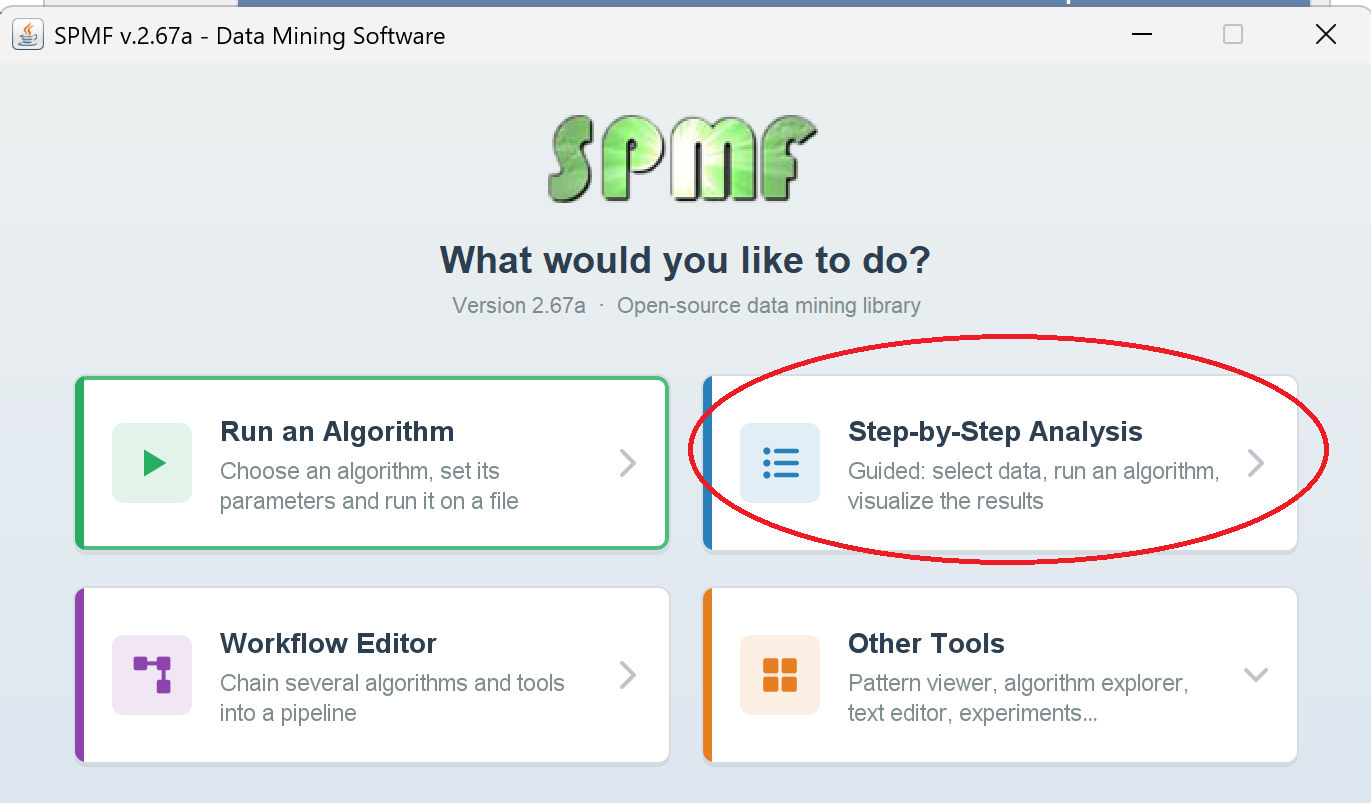
2) If the previous step succeeds, the Welcome window of SPMF will open::
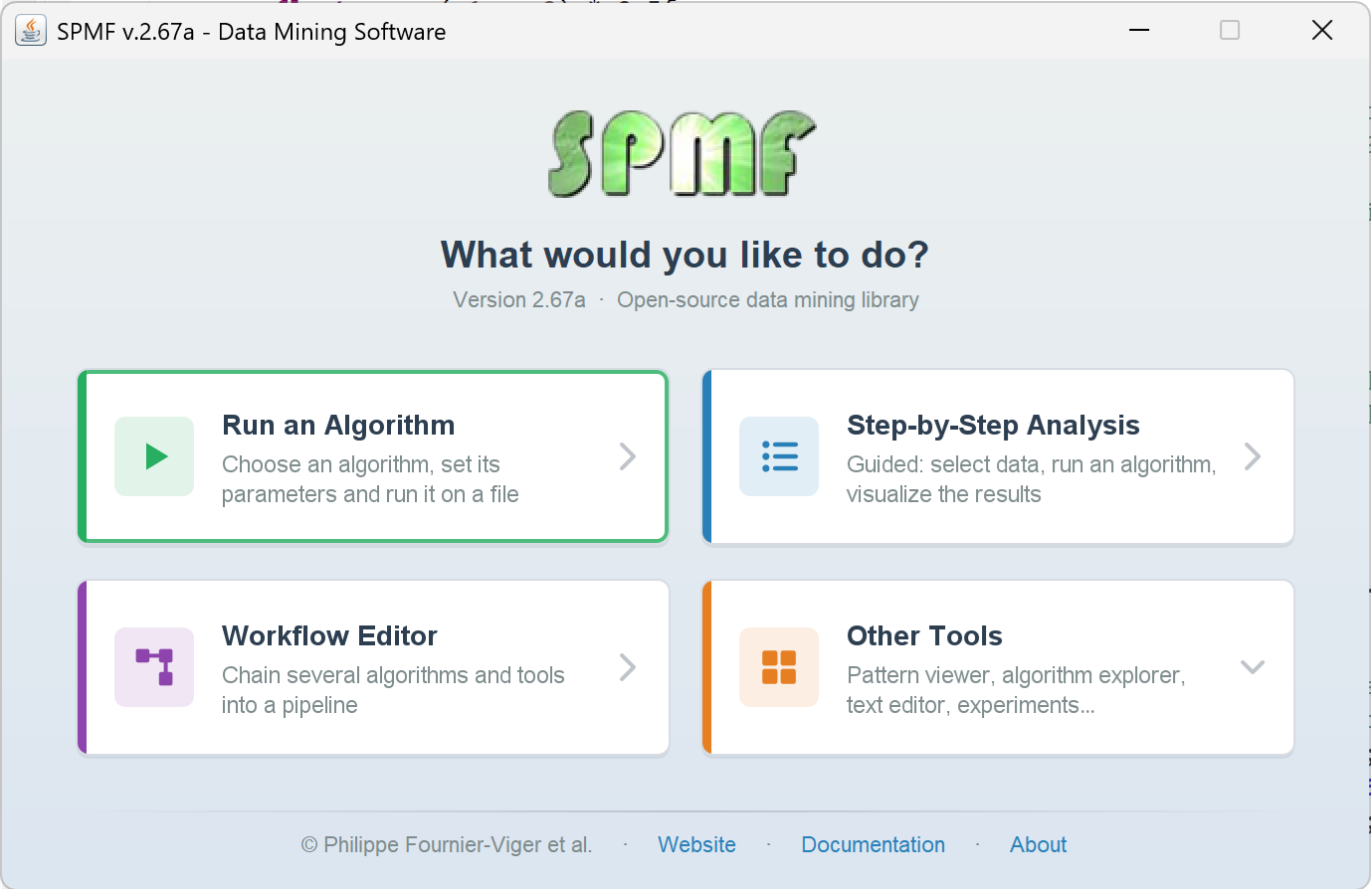
From this window four options are available:
- Run an algorithm: To run a single algorithm on some data. This is the most simple way to use SPMF to run an algorithm.
- Step-by-Step Analysis: This is a wizard-type interface that let you select data and perform other steps before running an algorithm.
- Workflow editor: This is a visual tool that allows to chain multiple algorithms in a pipeline to create a workflow and run it.
- Other tools: Provides several small tools that are included in SPMF such as a small text editor, an algorithm explorer tool, and developer tools.
Running an algorithm
1) For this simple tutorial, let's run a single algorithm by clicking on "Run an algorithm".
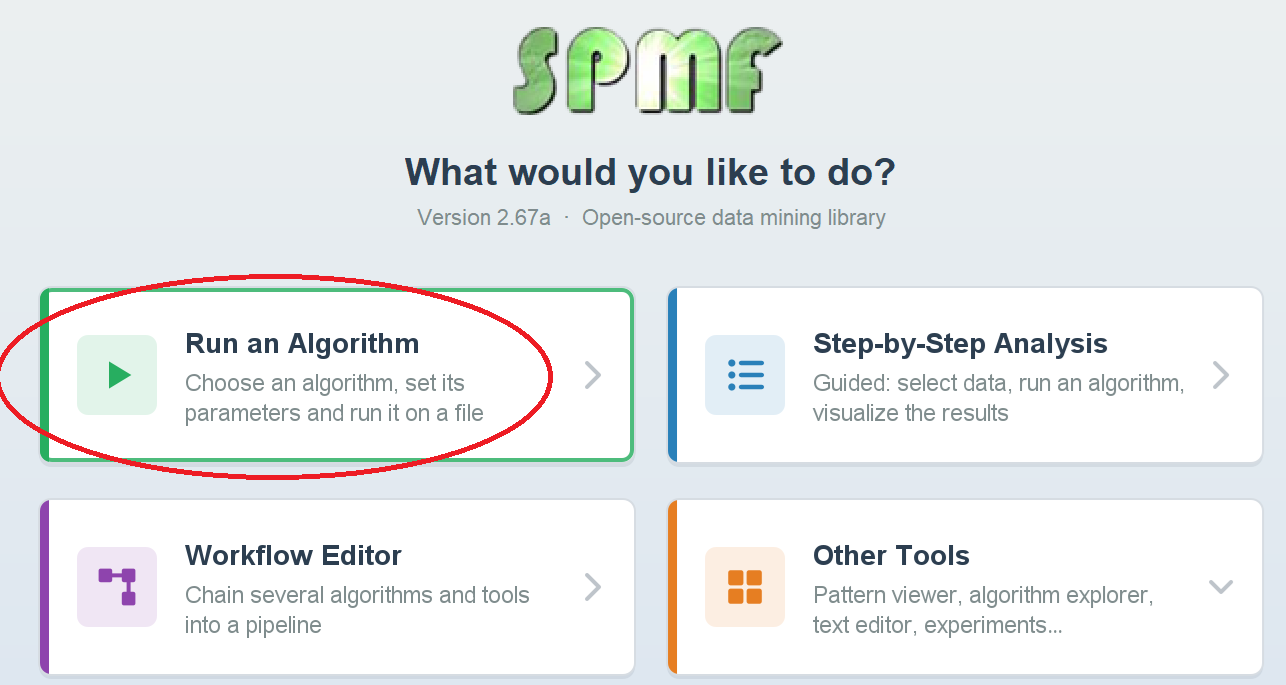
This opens this window:
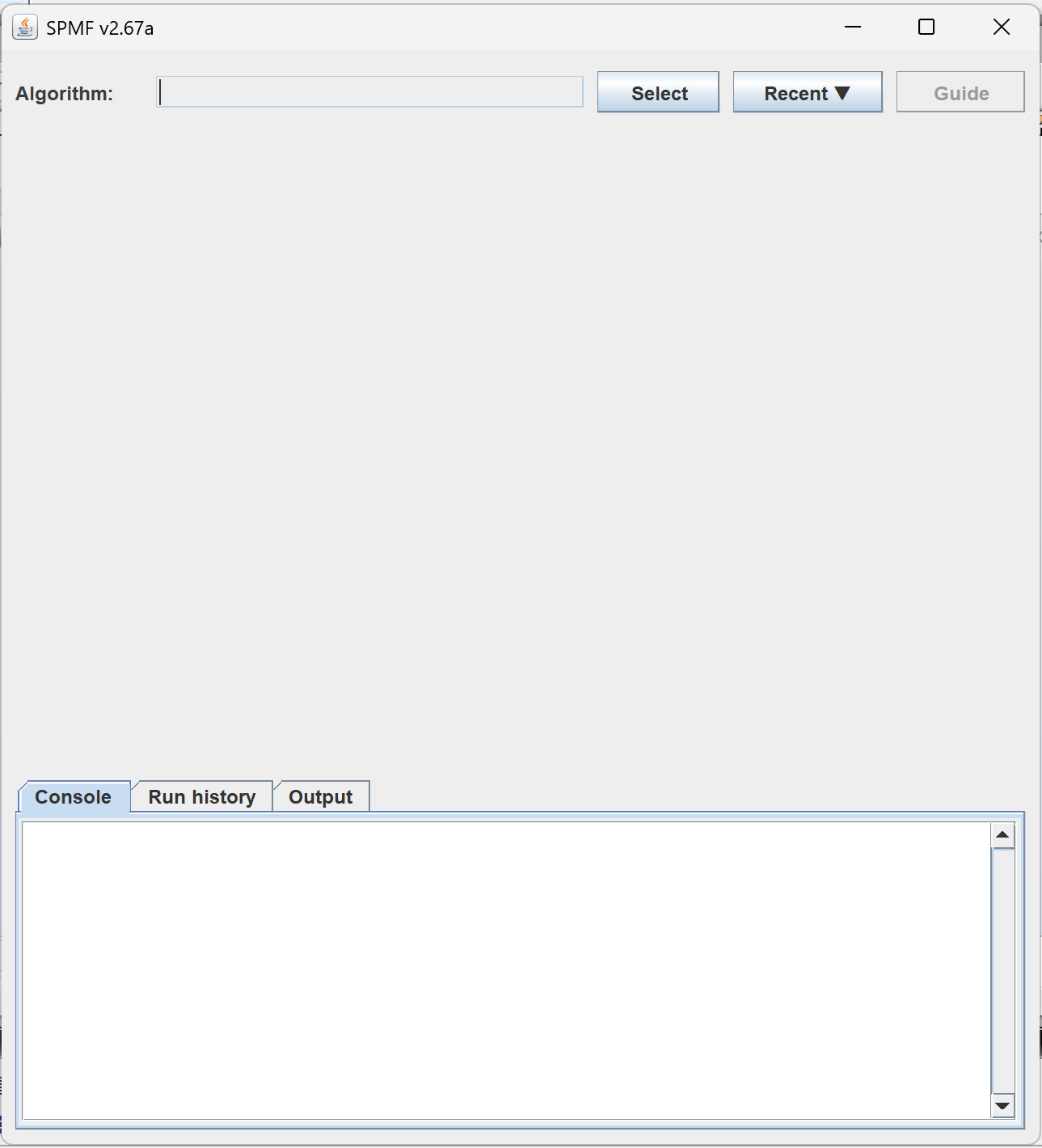
2) Now let's say that you want to run the CM-SPAM
algorithm. In the documentation, it is the CM-SPAM example. To run that example:
- Click on the "Select" button of the "Algorithm" row. This will open another window displaying all the algorithms, organized by categories:
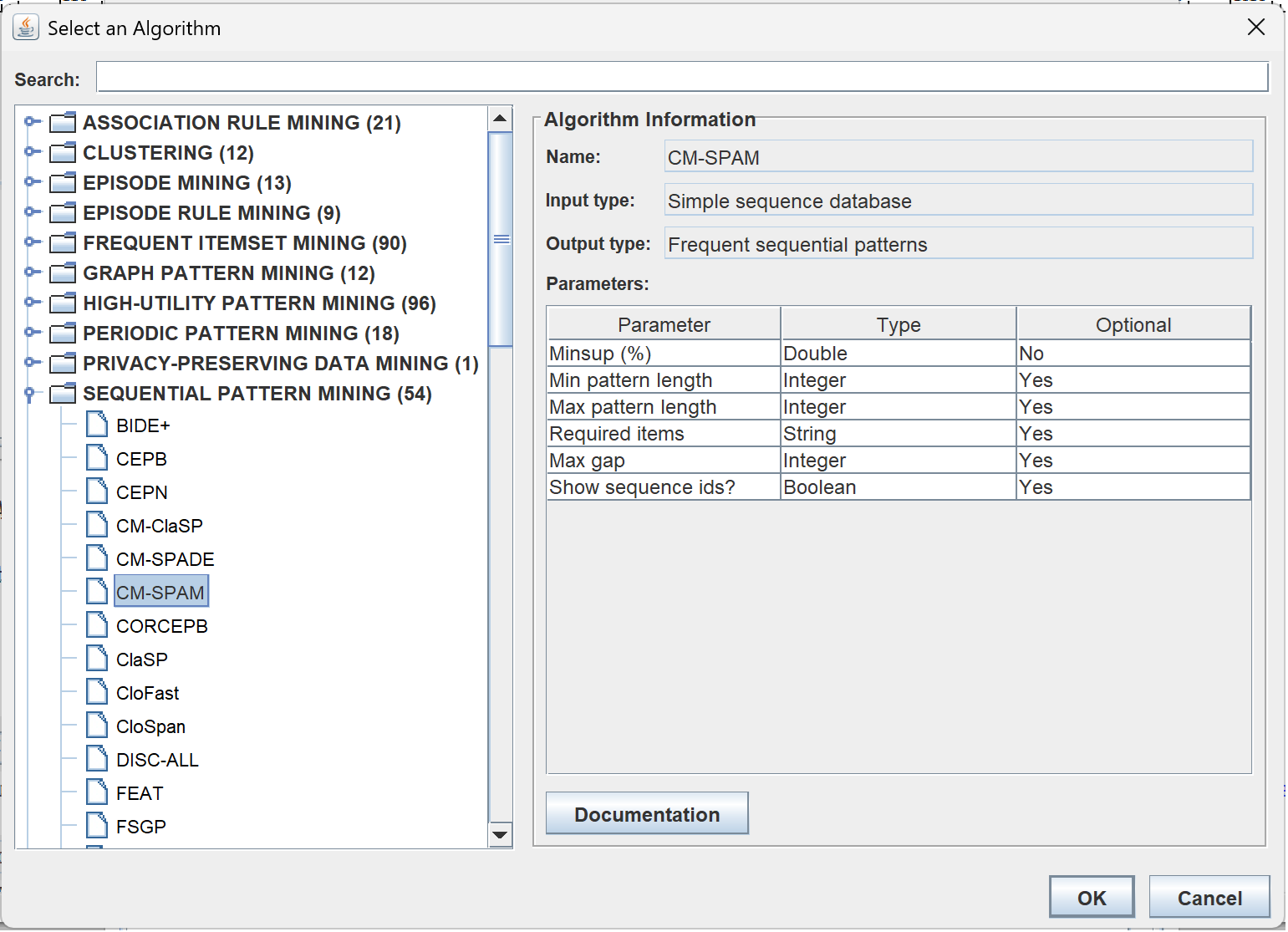
For this example, select the algorithm "CM-SPAM" and click OK.
- After that, click on the "Select" button on the"Input file" row to select an input file.

This will open a dialog to select the input file. Go to the test_files
folder on your desktop and select the file "contextPrefixSpan.txt"
(the file to be used is indicated in the CM-SPAM example).

- After that, click on the button "Select" button on the"Output file" row to select the location where the result should be saved. For example, go to the desktop
and write "result.txt" and click "OK".

- The next step is to set the parameter minsup
of the CM-SPAM algorithm. To do that, click in the
text field beside "Minsup (%)" and write 0.5
because it is the value used in the CM-SPAM example. There are also other parameters but they are marked as optional. Thus, we do not need to use them for this example.

- After that, click on "Run algorithm" to run the
algorithm.
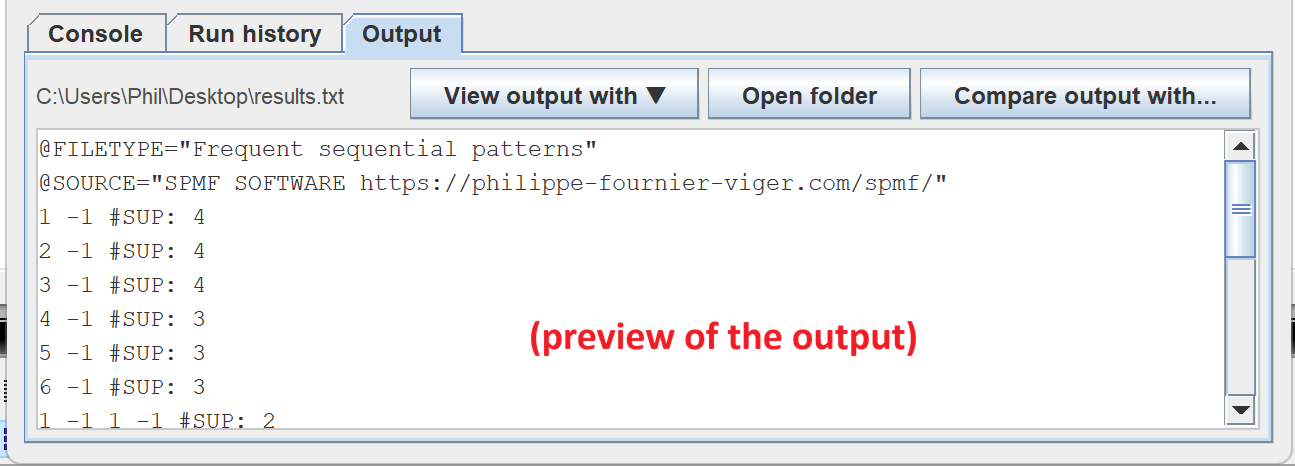
- When the algorithm terminates, the Output panel at the bottom of the window will flash and show a preview of the output file (the first 20 lines are displayed):
The output is a text file and the content looks like this:
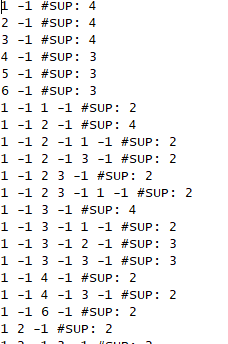
These results are the sequential patterns discovered by CM-SPAM. These results are explained in the CM-SPAM example of the documentation.
Because looking at a text file like this is not very intuitive, I will show you how to use visualization tools.
- To view the results in a more intuitive way, click on the button "View output with" button. This opens a menu with several tools for viewing the results.
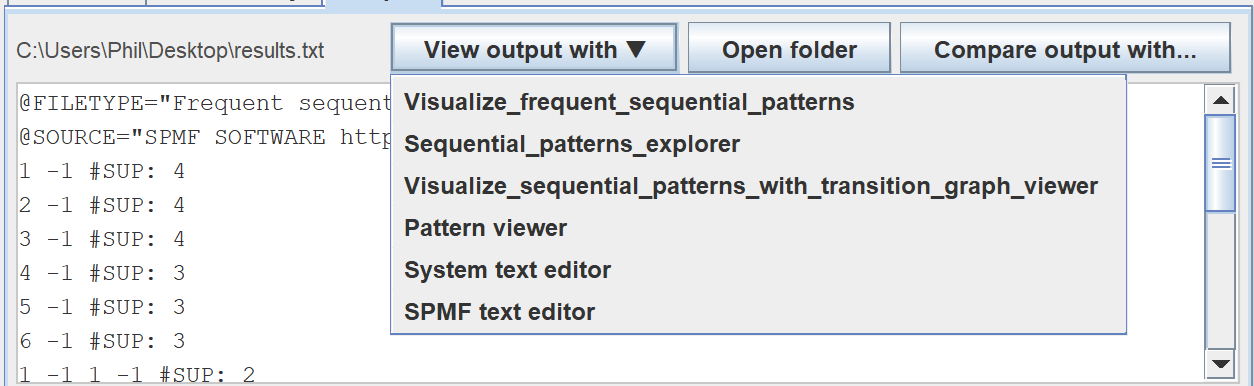
From this menu, you can select the "Visualize_frequent_sequential_patterns" tool. This will open another window that display the sequential patterns visually, like this:
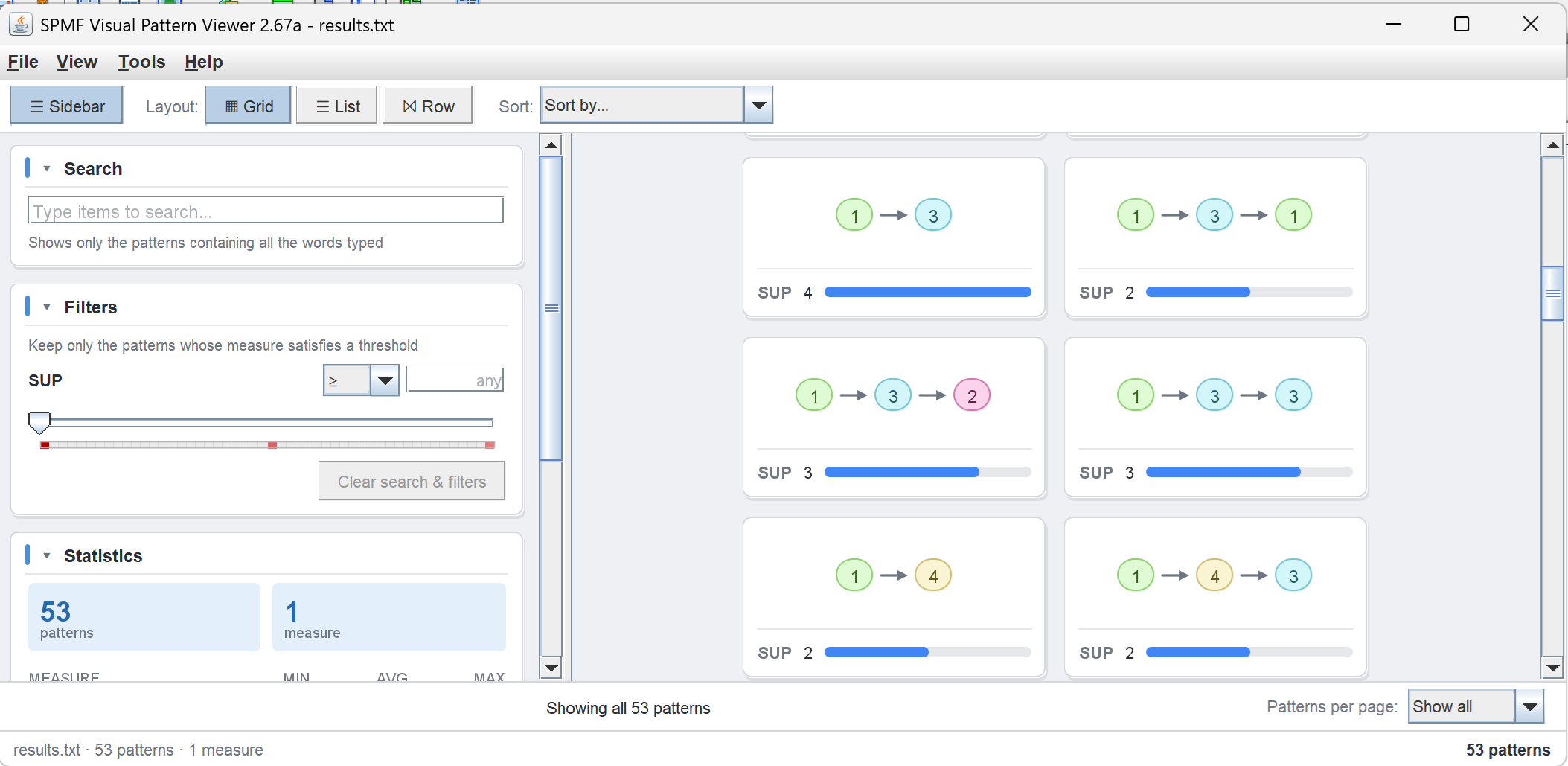
There are also several tools that are provided for opening output files for each algorithm. Those are described in more details in the documentation pages of the SPMF website.
- In the window for running N algorithm there is also a "console panel" that allows to view statistics about the algorithm execution such as how much time and memory was used:
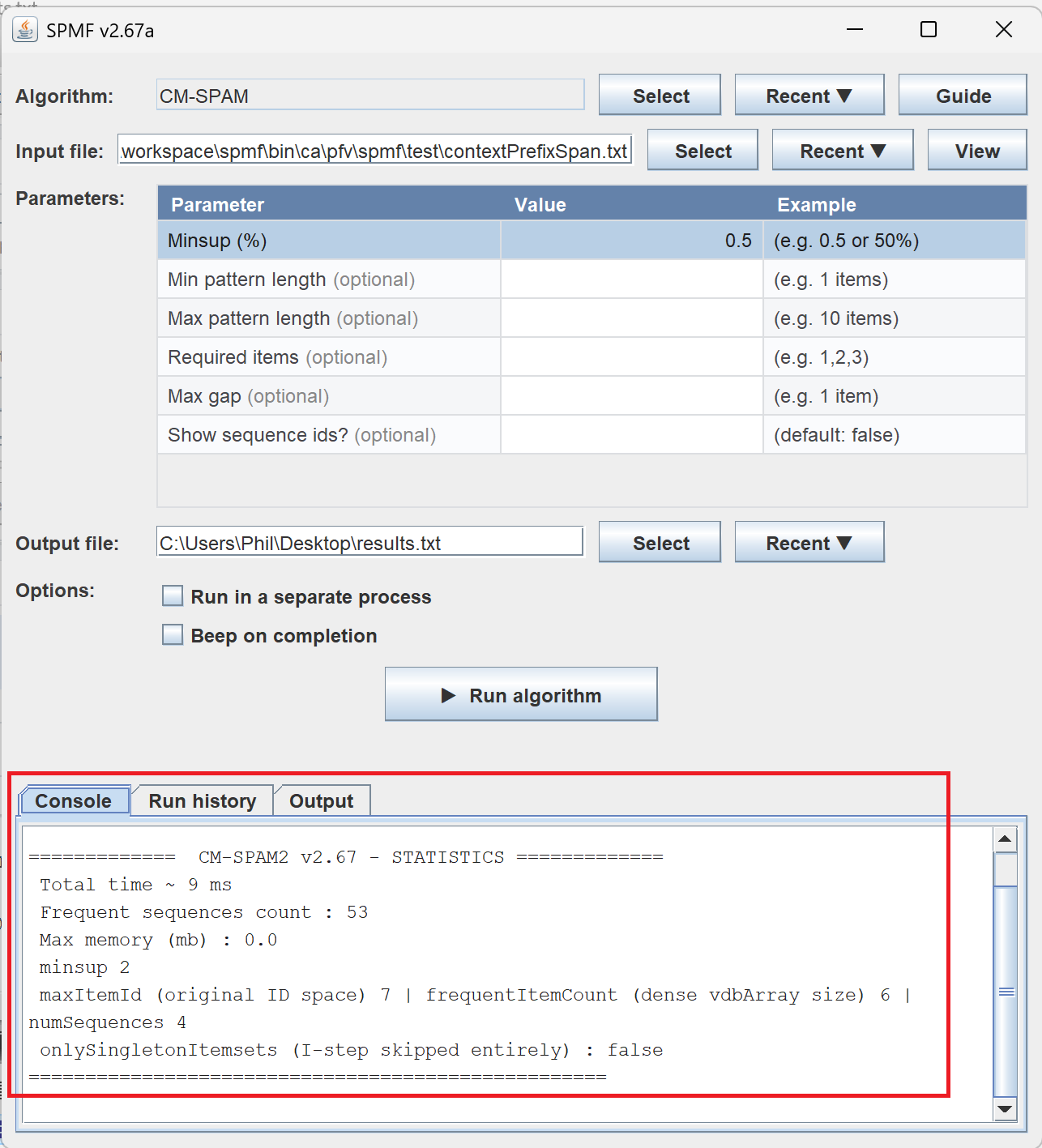
After completing these steps, you now know how to run a single algorithm with SPMF. You may repeat the above step to run other algorithms or change the paramters of the algorithm. Each algorithm with their parameters, input and output are described in the documentation of SPMF.
How to create workflows to run multiple algorithms with SPMF?
From the welcome window of SPMF, there are another mode that can be used for running algorithms from SPMF called the Workflow editor.
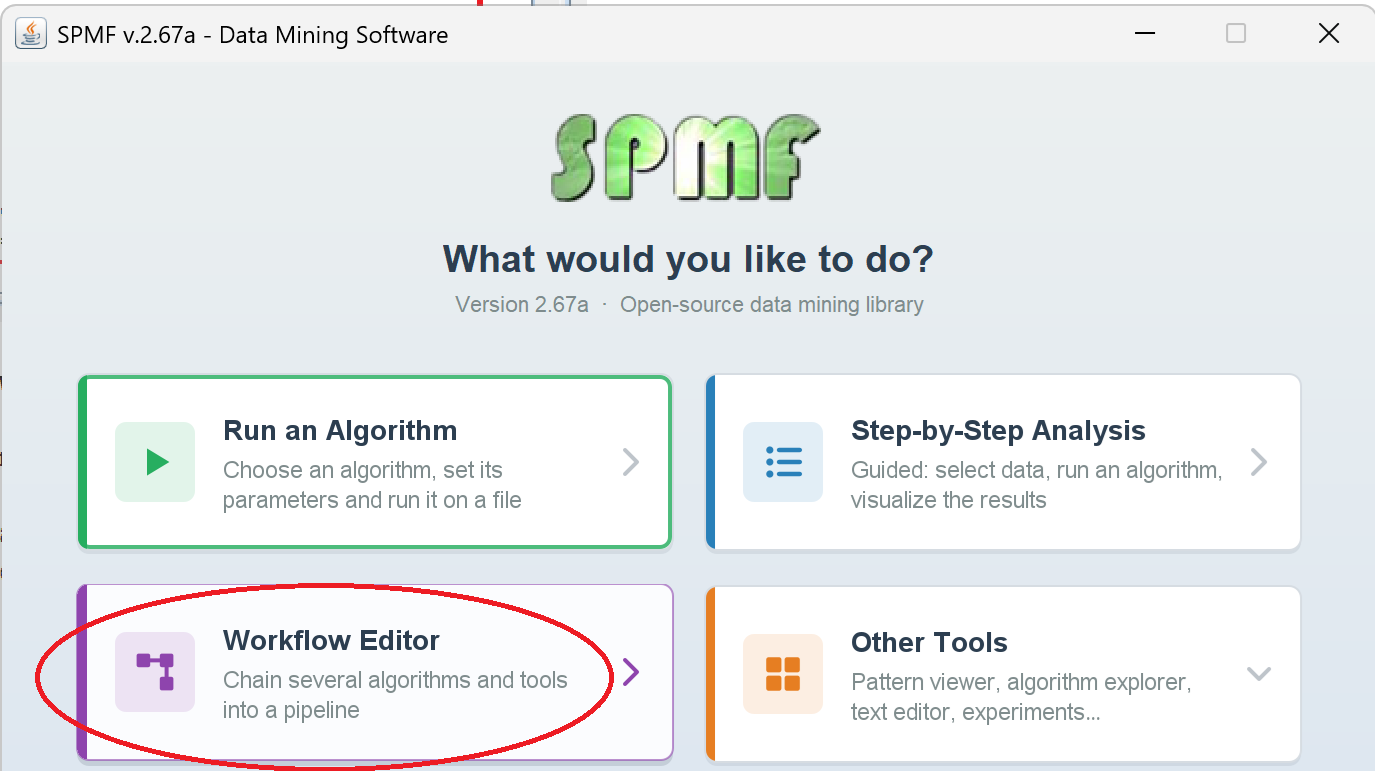
The Workflow editor is used to create worklows where multiple algorithms are run one after another rather than running only one algorithm at a time. A worklow is a visual representation of how multiple algorithms are run one after the other. For example a simple workflow below indicates to apply the Eclat algorithm on the chess.txt input file, which will produce a file output1.txt, and then apply two other algorithms for visualizing the output and opening the text file with a text editor.
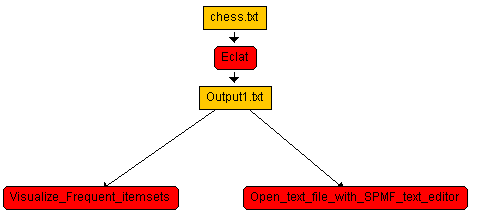
Please see the documentation page of the workflow editor dedicated to this tool for more details about how to use it to create workflows.
How to perform step-by-step analysis with SPMF?
From the welcome window of SPMF, there is also a third mode that can be used for running algorithms from SPMF called the Step-by-Step Analysis.
..... < the documentation for this mode will be updated soon >